Wednesday, March 19, 2014

Wednesday, December 04, 2013
A bit of poetry success
The 26 Words exhibition – "exploring the DNA of language" – opened in London last week. Among the works on display was the piece that I made with Mark Noad, inspired by the death of my mum earlier in the year.
Here's the project in a nutshell: Take 26 pairs of writers and artists – one for each letter of the alphabet – and challenge them to make something inspired by a random word that starts with that letter. My letter was H and my word was Hearse.
I was a bit nervous about going along to see my finished piece on the opening night. I mingled busily, grazed on wine and crisps, took my time looking at other people's work, and put off the moment when I'd have to go over and actually look at mine.
But it went very well. Someone whose views I value a lot said it was "brilliantly clever and profoundly moving". A few other people said they were touched by it. And a very nice man called Jerome liked it so much that he got his wallet out and bought it, there and then.
The show – with fantastic work from 26 other writers – is at the Free Word Centre in London until January and then goes on tour. But in the meantime, here's my bit. It's called "Hearse rake the coals of my heart"...
And if you can't read the words...
And here's the story of how I wrote it (you can read Mark's side of things here):
My word, Hearse, was chosen for me on the day my Mum died. She had a massive brain haemorrhage at home and never woke up. I appreciated the irony of the coincidence, as my Mum would have done, and decided not to ask for a different word.
Initially I thought I could put my Mum out of my thoughts and write something hearse-related that had nothing to do with her. It didn’t seem fair to dump all my grief onto Mark, my collaborator. And my Mum’s death was the last thing I wanted to write about, or even think about.
So I began on safe ground, researching the etymology of my word. A hearse was originally a framework for candles that hung over a coffin. Its root is in the Old French herce – a long rake or harrow. That gave me a line, “Hearse, rake the coals of my heart”, which eventually became our title.
Next I discovered hearse-owner clubs, watched promotional videos for funeral industry trade shows, thought about roadside memorial shrines, marvelled at the literalness of the German word for hearse – Leichenwagen, corpse wagon.
Bewildered by the possibilities, and with a deadline looming, I decided to give myself a constraint. I would write a palindrome – a string of words that can be read backwards as well as forwards. This was tricky, but fun. I was pleased with the result.
But I decided it wasn’t good enough. It just didn’t say anything. And I had a nagging sense that I was avoiding what I really ought to be writing about. Then I noticed that the word I’d been trying to dodge – mum – was itself a palindrome. That seemed like a sign to carry on, and to dig deeper.
So I started again. I wrote mum in the middle of a big sheet of paper and built a new palindrome around it. I wanted that central word to be a turning point. Everything leading up to it would be in one voice, with one meaning; everything afterwards would mean something very different.
This was hard and painful. I wanted to write something that was about loss and regret and love and forgiveness. It would be inspired by my mum, but I wanted to leave room for other people to relate to it in their own way.
Before Mark and I agreed the final text, we both felt one last change was needed. The word at the centre of the piece, around which everything revolved, had to go. For me it was a painful cut, but also a release. What remains can stand on its own.
Here's the project in a nutshell: Take 26 pairs of writers and artists – one for each letter of the alphabet – and challenge them to make something inspired by a random word that starts with that letter. My letter was H and my word was Hearse.
I was a bit nervous about going along to see my finished piece on the opening night. I mingled busily, grazed on wine and crisps, took my time looking at other people's work, and put off the moment when I'd have to go over and actually look at mine.
But it went very well. Someone whose views I value a lot said it was "brilliantly clever and profoundly moving". A few other people said they were touched by it. And a very nice man called Jerome liked it so much that he got his wallet out and bought it, there and then.
The show – with fantastic work from 26 other writers – is at the Free Word Centre in London until January and then goes on tour. But in the meantime, here's my bit. It's called "Hearse rake the coals of my heart"...
 |
| Hearse rake the coals of my heart |
And if you can't read the words...
Hearse rake the coals of my heart
More wanted
Never agreed
Everything regretted
Nothing said beautifully
Lived inconsequentially
Failed completely.
Listen.
Love.
Remember this need.
You cry: please...
Please cry
You need this
Remember, love
Listen completely.
Failed inconsequentially
Lived beautifully
Said nothing regretted
Everything agreed
Never wanted more.
And here's the story of how I wrote it (you can read Mark's side of things here):
My word, Hearse, was chosen for me on the day my Mum died. She had a massive brain haemorrhage at home and never woke up. I appreciated the irony of the coincidence, as my Mum would have done, and decided not to ask for a different word.
Initially I thought I could put my Mum out of my thoughts and write something hearse-related that had nothing to do with her. It didn’t seem fair to dump all my grief onto Mark, my collaborator. And my Mum’s death was the last thing I wanted to write about, or even think about.
So I began on safe ground, researching the etymology of my word. A hearse was originally a framework for candles that hung over a coffin. Its root is in the Old French herce – a long rake or harrow. That gave me a line, “Hearse, rake the coals of my heart”, which eventually became our title.
Next I discovered hearse-owner clubs, watched promotional videos for funeral industry trade shows, thought about roadside memorial shrines, marvelled at the literalness of the German word for hearse – Leichenwagen, corpse wagon.
Bewildered by the possibilities, and with a deadline looming, I decided to give myself a constraint. I would write a palindrome – a string of words that can be read backwards as well as forwards. This was tricky, but fun. I was pleased with the result.
But I decided it wasn’t good enough. It just didn’t say anything. And I had a nagging sense that I was avoiding what I really ought to be writing about. Then I noticed that the word I’d been trying to dodge – mum – was itself a palindrome. That seemed like a sign to carry on, and to dig deeper.
So I started again. I wrote mum in the middle of a big sheet of paper and built a new palindrome around it. I wanted that central word to be a turning point. Everything leading up to it would be in one voice, with one meaning; everything afterwards would mean something very different.
This was hard and painful. I wanted to write something that was about loss and regret and love and forgiveness. It would be inspired by my mum, but I wanted to leave room for other people to relate to it in their own way.
Before Mark and I agreed the final text, we both felt one last change was needed. The word at the centre of the piece, around which everything revolved, had to go. For me it was a painful cut, but also a release. What remains can stand on its own.
 |
| A sneaky shot of someone looking at Hearse... |
 |
| Me with Jerome, who bought Hearse... (hence I'm smiling) |
Wednesday, October 09, 2013
Plant life
My main contribution to the gardening at home is to cut the grass and dig holes where I'm told to. But I enjoyed the ceramic flowers I found on a summer visit to the Botanic Gardens in Ventor.
Frances Doherty's pieces were strange, unexpected and beautiful. I particularly liked the simple words that came with them. A glimpse of the story behind each work made for an engaging encounter.
"Scruffy" hydrangeas...

While cycling in Holland...

Scarlet poppies...

From another inspiring cycle with friends...

Frances wasn't the only person planting pleasing words in the Ventnor garden. I think this is the best "sorry for the mess...." sign I've ever read.



Frances Doherty's pieces were strange, unexpected and beautiful. I particularly liked the simple words that came with them. A glimpse of the story behind each work made for an engaging encounter.
"Scruffy" hydrangeas...

While cycling in Holland...

Scarlet poppies...


Frances wasn't the only person planting pleasing words in the Ventnor garden. I think this is the best "sorry for the mess...." sign I've ever read.


Friday, October 04, 2013
How to find story ideas
Where do I get my short story ideas from? Mainly I just make them up. But once in a while I'll find something like this, an item in my local newspaper.
What makes this the germ of a good story? For me, it's not the fact that this arch criminal was trying to escape the police in a kayak, or that his desire to start a new life in France was so spontaneously random. No, it's the fact that he was wearing a child's life jacket.

What makes this the germ of a good story? For me, it's not the fact that this arch criminal was trying to escape the police in a kayak, or that his desire to start a new life in France was so spontaneously random. No, it's the fact that he was wearing a child's life jacket.

Wednesday, September 18, 2013
The strange power of the pen
Every year, when I take a summer holiday, the first items to go into my suitcase are always the same. I pack my notebook, a spare notebook, my pens, spare ink, a few pencils – my writing tools and accoutrements.
And that’s where they stay – in the suitcase.
I always think that when I’m away from the daily routine, when I have spare time in abundance, I’ll get lots of writing done.
Actually, I don’t get lots of writing done. I don’t get any done.
But that wasn’t quite true this summer. I did sit down for ten whole minutes in August to make a few notes about a woman called Dora.
Dora owned the house we were renting on the island of Brac, Croatia. She came by one day to drop off some clean sheets and we got chatting.
She told me how she’d bought the place as a ruin ten years ago. Originally it was a mill. Her husband renovated it as a hobby. His day job is teaching maths.
She’d lived in this village – Bol – all her life. Her husband came from Murvica, a hamlet along the coast that only recently became accessible by road.
I decided to ask Dora about something that had been puzzling me.
The five-minute walk from our holiday house to the sea goes past a derelict modernist hotel. It looked to me like a prime piece of property, ideal for investment. (And Bol is a classy beach town that’s had plenty of money spent on it since the Yugoslav wars of the 1990s.)
How had the hotel got into such a mess, and why had nobody fixed it up?
Dora’s English faltered at this point.
The problem had something to do with a dispute between the Catholic Church and the state, she explained in a vague way.
One of them owned the land – I couldn’t quite understand which – and the other was blocking its redevelopment.
“Before they were ok, now they are like this,” she said, punching one fist with the other.
I asked why, but she changed the subject.
I had the feeling that our conversation about pool maintenance and how many towels I might need had strayed into territory she found uncomfortable. It’s easy to forget; 20 years ago the people hereabouts were shooting their neighbours.
It interests me that I scribbled down some notes about our chat. I’d say that I pressed Dora to talk about something she was reluctant to discuss because I’m naturally curious. (Although my wife says I’m just nosey)
But I wonder, was I subconsciously driven by all those unfilled notebook pages? Even when the pen stays in the suitcase, does it still exert a strange power?
And that’s where they stay – in the suitcase.
I always think that when I’m away from the daily routine, when I have spare time in abundance, I’ll get lots of writing done.
Actually, I don’t get lots of writing done. I don’t get any done.
But that wasn’t quite true this summer. I did sit down for ten whole minutes in August to make a few notes about a woman called Dora.
Dora owned the house we were renting on the island of Brac, Croatia. She came by one day to drop off some clean sheets and we got chatting.
She told me how she’d bought the place as a ruin ten years ago. Originally it was a mill. Her husband renovated it as a hobby. His day job is teaching maths.
She’d lived in this village – Bol – all her life. Her husband came from Murvica, a hamlet along the coast that only recently became accessible by road.
I decided to ask Dora about something that had been puzzling me.
The five-minute walk from our holiday house to the sea goes past a derelict modernist hotel. It looked to me like a prime piece of property, ideal for investment. (And Bol is a classy beach town that’s had plenty of money spent on it since the Yugoslav wars of the 1990s.)
How had the hotel got into such a mess, and why had nobody fixed it up?
Dora’s English faltered at this point.
The problem had something to do with a dispute between the Catholic Church and the state, she explained in a vague way.
One of them owned the land – I couldn’t quite understand which – and the other was blocking its redevelopment.
“Before they were ok, now they are like this,” she said, punching one fist with the other.
I asked why, but she changed the subject.
I had the feeling that our conversation about pool maintenance and how many towels I might need had strayed into territory she found uncomfortable. It’s easy to forget; 20 years ago the people hereabouts were shooting their neighbours.
It interests me that I scribbled down some notes about our chat. I’d say that I pressed Dora to talk about something she was reluctant to discuss because I’m naturally curious. (Although my wife says I’m just nosey)
But I wonder, was I subconsciously driven by all those unfilled notebook pages? Even when the pen stays in the suitcase, does it still exert a strange power?
 |
| Not the best place in town |
 |
| Even worse inside |
Thursday, July 18, 2013
How I became a highly successful novelist
Yesterday, I discovered that I am a highly successful novelist. It was quite a surprise. I’ve not managed to write a novel, never mind publish one.
But I have started two – maybe more, my hard drive is so cluttered. With the first, I got to about 27,000 words before I stopped. The second is about 60,000 words. I stopped that one too.
Until the day before yesterday, that made me sound like a failed novelist. Even a gutless one. I hadn’t just not made it, I’d given up. Twice.
But that’s not the case.
The aim with the first book was to write every day for three weeks – a continuous narrative, with the words accruing day by day. Job done.
For the second book, I wanted to reach 60,000 words. Again, job done.
I set my novel-writing goals and I achieved them. Hence I am a successful novelist.
The day before yesterday, when I was a failed novelist, I used to look back on my failures and wonder what went wrong. How could I avoid failure next time?
I’d need a rigid writing routine. I’d need a clear, detailed plot outline. I’d need to know what sort of WRITER I wanted to be. And I’d need time. Lots and lots of extra time.
Now that I’ve realised I’m a successful novelist, my thinking has changed.
I’m looking back on my two triumphs. Thinking about what worked, what success has taught me.
I know I can write a lot of words. That’s good. I can write every day, regardless of how busy I am with other stuff. When I’ve got no idea what happens next, I can make things up.
I’ve learnt that I’m flexible about process. I can write at home, on the train; out shopping, out running; on my own, with friends.
I can use Word. Pages. Scrivener. Ommwriter. I can use my laptop or a typewriter. I can use pens or pencils. Expensive notebooks, cheap notebooks. Scraps of paper. Sticky notes. Glue. String.
The main thing I’ve learned is this: I like doing it.
I like doing it so much that even if a pernicious virus deleted every draft as soon as I typed The End, I’d still keep doing it.
Now it’s true that I might have written an enormous amount of dross. But I think the same could apply to a lot of other novelists, many of those whose “success” is measured by more traditional yardsticks – such as sales, fame, critical acclaim.
What I do know is that whenever I’ve been writing my novels, I’ve had fun. Well, it wasn’t always fun. But it was satisfying. Hugely.
So I’m a success. Is that a reasonable conclusion, or an absurd act of self-delusion? Or both? And does the answer matter? I don’t think so.
But I have started two – maybe more, my hard drive is so cluttered. With the first, I got to about 27,000 words before I stopped. The second is about 60,000 words. I stopped that one too.
Until the day before yesterday, that made me sound like a failed novelist. Even a gutless one. I hadn’t just not made it, I’d given up. Twice.
But that’s not the case.
The aim with the first book was to write every day for three weeks – a continuous narrative, with the words accruing day by day. Job done.
For the second book, I wanted to reach 60,000 words. Again, job done.
I set my novel-writing goals and I achieved them. Hence I am a successful novelist.
The day before yesterday, when I was a failed novelist, I used to look back on my failures and wonder what went wrong. How could I avoid failure next time?
I’d need a rigid writing routine. I’d need a clear, detailed plot outline. I’d need to know what sort of WRITER I wanted to be. And I’d need time. Lots and lots of extra time.
Now that I’ve realised I’m a successful novelist, my thinking has changed.
I’m looking back on my two triumphs. Thinking about what worked, what success has taught me.
I know I can write a lot of words. That’s good. I can write every day, regardless of how busy I am with other stuff. When I’ve got no idea what happens next, I can make things up.
I’ve learnt that I’m flexible about process. I can write at home, on the train; out shopping, out running; on my own, with friends.
I can use Word. Pages. Scrivener. Ommwriter. I can use my laptop or a typewriter. I can use pens or pencils. Expensive notebooks, cheap notebooks. Scraps of paper. Sticky notes. Glue. String.
The main thing I’ve learned is this: I like doing it.
I like doing it so much that even if a pernicious virus deleted every draft as soon as I typed The End, I’d still keep doing it.
Now it’s true that I might have written an enormous amount of dross. But I think the same could apply to a lot of other novelists, many of those whose “success” is measured by more traditional yardsticks – such as sales, fame, critical acclaim.
What I do know is that whenever I’ve been writing my novels, I’ve had fun. Well, it wasn’t always fun. But it was satisfying. Hugely.
So I’m a success. Is that a reasonable conclusion, or an absurd act of self-delusion? Or both? And does the answer matter? I don’t think so.
Friday, July 12, 2013
The joys of making yourself look stupid
Trying to do anything creative or different is a risky business. You might end up looking stupid. Your efforts might fail in a way that makes you unhappy. Try it at work and you could lose your job.
In the balance of putting yourself on the line versus playing safe, the scales are tipped heavily towards safe. That’s because the opposite of safe is vulnerable, and most people don’t like to feel vulnerable.
I remember coming across the trade off when I studied interpersonal psychology at Birkbeck years ago. We looked at the odd ways people behave when they try to talk to each other. All those strategies aimed at saving face, not giving away too much, keeping your exit routes open.
I watched a great TED talk earlier in the week called The Power of Vulnerability. Brene Brown explains why we try to avoid vulnerability and how – just maybe – the secret of happiness is to accept it. Or even to embrace it.
I used to feel vulnerable a lot. Sometimes I still do. Quite often, actually, now I think about it. But it doesn’t bother me so much. I go looking for opportunities to make myself vulnerable. I read stories to people in the street, I prance about on stage, I try to write words that move people.
I’m not sure when this change occurred or why. But I’m glad it did.
I think if you want to make a connection with people, you have to take the risk that it might all go horribly wrong – or maybe just a little bit wrong.
You can play safe and put nothing at stake. You’ll limit your losses. But then you’ll limit your rewards, too.
In the balance of putting yourself on the line versus playing safe, the scales are tipped heavily towards safe. That’s because the opposite of safe is vulnerable, and most people don’t like to feel vulnerable.
I remember coming across the trade off when I studied interpersonal psychology at Birkbeck years ago. We looked at the odd ways people behave when they try to talk to each other. All those strategies aimed at saving face, not giving away too much, keeping your exit routes open.
I watched a great TED talk earlier in the week called The Power of Vulnerability. Brene Brown explains why we try to avoid vulnerability and how – just maybe – the secret of happiness is to accept it. Or even to embrace it.
I used to feel vulnerable a lot. Sometimes I still do. Quite often, actually, now I think about it. But it doesn’t bother me so much. I go looking for opportunities to make myself vulnerable. I read stories to people in the street, I prance about on stage, I try to write words that move people.
I’m not sure when this change occurred or why. But I’m glad it did.
I think if you want to make a connection with people, you have to take the risk that it might all go horribly wrong – or maybe just a little bit wrong.
You can play safe and put nothing at stake. You’ll limit your losses. But then you’ll limit your rewards, too.
Friday, April 26, 2013
Building bridges
With the sudden death of my Mum last week, I nearly cancelled the event I'd planned for World Book Night on Tuesday. I wasn't sure I was in the right frame of mind to host a short story slam or to perform my "on-the-spot writing" shtick. But I'm glad I went ahead with it.
For one, I know my Mum would have wanted me to carry on as planned. She'd have hated her passing to have inconvenienced anyone. And I didn't want to let the organisers down; something Mum – and Dad – instilled in me when I was growing up.
So off I went to Guildford library. First, I helped to introduce a group of "rising star" writers to an audience of 130 eager readers. Later in the evening, I was interviewed by the local radio station and I hosted the story slam – both were great fun. But it was how I spent the time in between that I want to blog about.
I'd been asked to repeat the challenge I took on last summer, when I was resident in a Whitstable bookshop, writing stories for whoever came in that day – and doing it fast enough so that I could perform a quick reading of the story and give it to the customer to take away.
I wandered around the library, notebook in hand, approaching people at random and saying, "I'm a writer, would you please inspire me?"
The first person I met was Noreen. The easiest way you can inspire me, I said, is to tell me your favourite word. She didn't even have to think about it: "sleep", she said. Why? She has a young son and is studying in her "spare" time to get the qualifications she needs to change her career. Why does she want to change her career? Because it will help her find meaning in her life, she said.
That begged a question I felt I had to ask: do you feel your life lacks meaning at the moment? She reflected on this for a while. Then she smiled and said no, it doesn't. Her child gives it meaning. But she wanted more, perhaps some meaning she'd made herself. Hence she was studying.
I thanked her, found a quiet corner, and started scribbling. Here is Noreen, with the words she inspired:
Next I went and sat with a man called David. I started to explain why I wanted to talk to him, but he interrupted and went off on a beautiful riff of his own. First, he told me why his nose was bloodied: he'd come straight from the youth club where, chasing some of the kids around, he'd tripped over a plastic box and landed on his face. With that explanation out of the way, he told me about his interest in depression, the consequences of a Baptist upbringing, his role in the introduction of factory fishing to British waters, and the risks of offending family members when writing memoir (he's working on one, sometimes using an alter-ego he calls Doug).
He was sitting with his wife, Stevie, who finished off a few of his sentences and corrected any errors of fact or exaggeration. He called himself Dave, she preferred David. They reminded me of my Mum and Dad.
As with Noreen, I thanked David, found a quiet corner, and tried to write a few words inspired by what he had shared with me. Here he is, with his words:
I found both Noreen and David later in the evening, read them the words they'd inspired and gave them my pencil version, written on the back of a card like this:

I don't make any claims about the quality of the words I wrote in such haste; perhaps the value is in the process. I felt I made a connection with both David and Noreen, and that please me. Always when writing, I'm trying to make a connection that moves the reader. But it's easy to forget that good "writing" moves the writer, too – and that the word "writing" applies to the process as much as the end result. It's a verb as much as a noun. A more specific word than connection would be bridge: the traffic can flow in both directions.
For one, I know my Mum would have wanted me to carry on as planned. She'd have hated her passing to have inconvenienced anyone. And I didn't want to let the organisers down; something Mum – and Dad – instilled in me when I was growing up.
So off I went to Guildford library. First, I helped to introduce a group of "rising star" writers to an audience of 130 eager readers. Later in the evening, I was interviewed by the local radio station and I hosted the story slam – both were great fun. But it was how I spent the time in between that I want to blog about.
I'd been asked to repeat the challenge I took on last summer, when I was resident in a Whitstable bookshop, writing stories for whoever came in that day – and doing it fast enough so that I could perform a quick reading of the story and give it to the customer to take away.
I wandered around the library, notebook in hand, approaching people at random and saying, "I'm a writer, would you please inspire me?"
The first person I met was Noreen. The easiest way you can inspire me, I said, is to tell me your favourite word. She didn't even have to think about it: "sleep", she said. Why? She has a young son and is studying in her "spare" time to get the qualifications she needs to change her career. Why does she want to change her career? Because it will help her find meaning in her life, she said.
That begged a question I felt I had to ask: do you feel your life lacks meaning at the moment? She reflected on this for a while. Then she smiled and said no, it doesn't. Her child gives it meaning. But she wanted more, perhaps some meaning she'd made herself. Hence she was studying.
I thanked her, found a quiet corner, and started scribbling. Here is Noreen, with the words she inspired:
 |
| Thanks, Noreen |
 |
| It wasn't enough, but she knew it wouldn't be. Each evening at 7.30 she put him to bed. And then she started her search. Beneath the cushions, behind the sofa, buried in the laundry pile: where was it, that person she used to be? |
He was sitting with his wife, Stevie, who finished off a few of his sentences and corrected any errors of fact or exaggeration. He called himself Dave, she preferred David. They reminded me of my Mum and Dad.
As with Noreen, I thanked David, found a quiet corner, and tried to write a few words inspired by what he had shared with me. Here he is, with his words:
 |
| Thanks, David |
 |
| Sometimes I call myself Doug, just to get away, just to step back from the edge. See this Abyss? It's always there, it's in my juices. I fear I will fall into it. But I've seen so much and I've done so much and I've so much left to do. So much to say. One day, I'll just be Dave. |
I found both Noreen and David later in the evening, read them the words they'd inspired and gave them my pencil version, written on the back of a card like this:

I don't make any claims about the quality of the words I wrote in such haste; perhaps the value is in the process. I felt I made a connection with both David and Noreen, and that please me. Always when writing, I'm trying to make a connection that moves the reader. But it's easy to forget that good "writing" moves the writer, too – and that the word "writing" applies to the process as much as the end result. It's a verb as much as a noun. A more specific word than connection would be bridge: the traffic can flow in both directions.
Monday, April 22, 2013
Life and its strange ironies
I was reading an interview with the author Terry Pratchett over lunch. Towards the end, he started talking about death – an event much on his mind, as he has early Alzheimer’s. “It's not morbid to talk about death,” he says. “Most people don't worry about death, they worry about a bad death.”
My Mum felt the same way, I think. She was diagnosed with non-Hodgkin’s Lymphoma last year. Her attitude to it was wonderfully stoical. The chemotherapy will either cure me or it won’t, she said. I don’t think she was putting on a brave face for my benefit. She trusted her doctors to do their best; she’d have the treatment and see what happened.
Mum beat her cancer, and was given the all-clear in January. She was busy regaining her fitness and making plans about what to do next. And then last Monday night she suffered a massive brain haemorrhage. On Wednesday afternoon she died.
From the moment a blood vessel deep in her brain burst, she never regained consciousness. But I’m glad that I had the chance to sit at her bedside and chat away telling stories with my Dad, brother and sister, as though Mum were wide awake, on the mend and waiting for her turn to pick up the story – or, more likely, to tell us we’d all got it arse about face before starting again with her own version.
Mum loved to tell a good story, and would have appreciated the narrative value of the many strange coincidences – or cruel ironies – that surrounded the nature and timing of her passing. And believe me, there were many of them. But as I’m sure she’d have pointed out, that is the way of the world. And whether she heard my words or not, I’m glad I had the chance to thank her for bringing me into it.
 |
| Mum and Dad in the stable he built. When she asked my why I was taking a photo of them both looking so scruffy, I told her I wanted to capture their natural habitat |
Monday, April 08, 2013
Bath time train story
I guess you might call this a 'found story'.
I overheard a girl on the train, talking on the phone to a friend.
I wrote down what she said...
I overheard a girl on the train, talking on the phone to a friend.
I wrote down what she said...
"So we spent five hours talking about our relationship and I told him we were splitting up. He phoned me later and he's in the bath, with his clothes on, crying. He says he's taken loads of sleeping pills, but they're herbal ones and they've given him diarrhoea. I mean, who wears their clothes in the bath?"
I think she maybe lacks empathy.
Tuesday, April 02, 2013
The story behind my Limehouse story
Now that my Limehouse story has been published (read it here), I thought I'd set out some thoughts about where the idea came from and how it developed.
I’ve already blogged about this project and my first visit to the area, when I took lots of photos and made pages of notes. The mile of the London Marathon route that I'd been commissioned to write about had so much potential. The challenge wasn’t to come up with an idea, but to find some sense in all the rambling thoughts it provoked.
Dickens was an obvious early starting point. My mile has a pub where, as a child, he was made to dance on the tables for money – a pub that features in at least one of his novels. But I wanted to dig deeper.
What about the wharves? Narrow Road is lined with them. These are the small docks, slipways and storehouses from which some of first – voluntary – passengers set sail to Australia.
One of them, Dunbar Wharf, was once the headquarters of the world's largest private shipping fleet. I read about its founder, Duncan Dunbar, the seventh son of a Scottish tenant farmer, who moved to London and made his fortune in wine and spirits. And I read about his son, also Duncan, who built the shipping business.
He named his largest ship the Duncan Dunbar, whether in honour of himself or his father nobody knew. I learned that it ran aground three years after his death off the coast of Brazil. Its captain landed his passengers on a sandspit and rowed 120 miles in an open boat to get help (everyone was rescued 10 days later). Another story told of a ship that caught fire off Australia – the last anyone saw of its captain was when, to rescue her from the flames, he threw his wife overboard.
I read the younger Duncan’s will to see what story ideas it might suggest, but felt my attention drawn back to the streets of Limehouse.
Next I researched Alderman Henry Potter, a mayor of Stepney, who gave his name to Potters Dwellings, an alms building on Limehouse Causeway.
I discovered that he once made an incredibly tedious, and obsequious, address to members of the royal family, which I read to no benefit. Then I became intrigued by the fact that Potters Dwelling had been renamed Saunders Close.
I learned that a Mr Saunders was the caretaker of the building during the second world war. It was renamed after him in honour of the valiant – but frustratingly unspecified – deeds he performed during the Blitz. I found someone who, before the war, attended the school next door, and remembered the building under its old name. She knew Mr Saunders had done something incredible, but didn't know what.
Finally I read about the Chinese community that used to live here, how they made it London's original Chinatown, before just about everyone moved to Soho. Many of them worked the early steam-liners that docked in London. It was only when these young hands arrived that they found their passage was one-way – they had no means of returning home and were destitute, unless they could find work on another ship. The idea of writing about one of them appealed.
I looked into this further. I read about Fu Man Chu and the Yellow Peril, Jack London's journeys into "The Abyss". I discovered that the Chinese community that took root on my mile were mainly from Canton and Southern China. Their compatriots from Shanghai lived about a mile to the northeast, around Pennyfields, Amoy Place and Ming Street.
I remembered that about a year ago I wrote a story based in Southern China for the children of my local primary school, one that took inspiration from ancient folk tales that mixed human and animal characters I started to wonder what might happen if I transported some of those characters to Victorian Limehouse – how would their hopes and fears manifest themselves in the London of 1892?
Along the way, I found myself reading the transcripts of trials held around that time at the Old Bailey, London's main criminal court. They captured a form of justice that was brief and brutal. The idea of characters bearing testament appealed. A line kept running through my head: "I am Sheep, some say I steal". It became the first line of my story.
The last step, I teamed up with my illustrator, Nick Parker. The need to brief Nick made me think more deeply about what my story was about, and what mood I was after. His response to early drafts, and his initial drawings, made me revise the piece endlessly – until the final deadline arrived, when I put down my pen, crossed my fingers and handed everything over to my editor, Rishi Dastidar. And there my story ends, or begins.
I’ve already blogged about this project and my first visit to the area, when I took lots of photos and made pages of notes. The mile of the London Marathon route that I'd been commissioned to write about had so much potential. The challenge wasn’t to come up with an idea, but to find some sense in all the rambling thoughts it provoked.
Dickens was an obvious early starting point. My mile has a pub where, as a child, he was made to dance on the tables for money – a pub that features in at least one of his novels. But I wanted to dig deeper.
What about the wharves? Narrow Road is lined with them. These are the small docks, slipways and storehouses from which some of first – voluntary – passengers set sail to Australia.
One of them, Dunbar Wharf, was once the headquarters of the world's largest private shipping fleet. I read about its founder, Duncan Dunbar, the seventh son of a Scottish tenant farmer, who moved to London and made his fortune in wine and spirits. And I read about his son, also Duncan, who built the shipping business.
He named his largest ship the Duncan Dunbar, whether in honour of himself or his father nobody knew. I learned that it ran aground three years after his death off the coast of Brazil. Its captain landed his passengers on a sandspit and rowed 120 miles in an open boat to get help (everyone was rescued 10 days later). Another story told of a ship that caught fire off Australia – the last anyone saw of its captain was when, to rescue her from the flames, he threw his wife overboard.
I read the younger Duncan’s will to see what story ideas it might suggest, but felt my attention drawn back to the streets of Limehouse.
Next I researched Alderman Henry Potter, a mayor of Stepney, who gave his name to Potters Dwellings, an alms building on Limehouse Causeway.
I discovered that he once made an incredibly tedious, and obsequious, address to members of the royal family, which I read to no benefit. Then I became intrigued by the fact that Potters Dwelling had been renamed Saunders Close.
I learned that a Mr Saunders was the caretaker of the building during the second world war. It was renamed after him in honour of the valiant – but frustratingly unspecified – deeds he performed during the Blitz. I found someone who, before the war, attended the school next door, and remembered the building under its old name. She knew Mr Saunders had done something incredible, but didn't know what.
Finally I read about the Chinese community that used to live here, how they made it London's original Chinatown, before just about everyone moved to Soho. Many of them worked the early steam-liners that docked in London. It was only when these young hands arrived that they found their passage was one-way – they had no means of returning home and were destitute, unless they could find work on another ship. The idea of writing about one of them appealed.
I looked into this further. I read about Fu Man Chu and the Yellow Peril, Jack London's journeys into "The Abyss". I discovered that the Chinese community that took root on my mile were mainly from Canton and Southern China. Their compatriots from Shanghai lived about a mile to the northeast, around Pennyfields, Amoy Place and Ming Street.
I remembered that about a year ago I wrote a story based in Southern China for the children of my local primary school, one that took inspiration from ancient folk tales that mixed human and animal characters I started to wonder what might happen if I transported some of those characters to Victorian Limehouse – how would their hopes and fears manifest themselves in the London of 1892?
Along the way, I found myself reading the transcripts of trials held around that time at the Old Bailey, London's main criminal court. They captured a form of justice that was brief and brutal. The idea of characters bearing testament appealed. A line kept running through my head: "I am Sheep, some say I steal". It became the first line of my story.
The last step, I teamed up with my illustrator, Nick Parker. The need to brief Nick made me think more deeply about what my story was about, and what mood I was after. His response to early drafts, and his initial drawings, made me revise the piece endlessly – until the final deadline arrived, when I put down my pen, crossed my fingers and handed everything over to my editor, Rishi Dastidar. And there my story ends, or begins.
 |
| Monkey! One of Nick's brilliant illustrations |
Sunday, February 10, 2013
A bit of competition success
One of my writing aims for this year is to enter more competitions. I'm off to a good start, placing second in a flash fiction challenge run by the Nottingham Festival of Words.
I don't normally enter comps. There's such a long gap between sending off a story and hearing the result; I'm too impatient. But my artist friend Elaine tipped me off to this one, so I thought I'd give it a go.
The brief was simple: tell a story in fifty words or less. I decided to polish up one of the stories that I wrote last summer, when I was hanging out in a Whitstable bookshop, writing flash fictions inspired by customers. (And thanks to the great people of ReAuthoring for that opportunity)
The story, originally called Anticipation, was inspired by a lovely lady called Anne. Somewhere beneath the piles of paper cluttering my desk, I've got her email address. I hope I can find it, so that I can thank her again.
Here's the finished version of the story, with its new name:
I don't normally enter comps. There's such a long gap between sending off a story and hearing the result; I'm too impatient. But my artist friend Elaine tipped me off to this one, so I thought I'd give it a go.
The brief was simple: tell a story in fifty words or less. I decided to polish up one of the stories that I wrote last summer, when I was hanging out in a Whitstable bookshop, writing flash fictions inspired by customers. (And thanks to the great people of ReAuthoring for that opportunity)
The story, originally called Anticipation, was inspired by a lovely lady called Anne. Somewhere beneath the piles of paper cluttering my desk, I've got her email address. I hope I can find it, so that I can thank her again.
Here's the finished version of the story, with its new name:
Another door opensI'm going to be repeating my "writing on the spot" experiment again in April, as part of an event celebrating World Book Night. But more about that later.
I told my husband that anticipation was everything. There is not enough suspense, I said. He thought for a year and said this: I will leave you for another woman, but I won’t tell you when – would that do? You are a year too late, I said, shutting the door.
 |
| Here's Anne again |
 |
| Here's the first draft, written in the bookshop |
Tuesday, January 29, 2013
Sit down and have a listen
| Vince |
At the back end of last year the Fates smiled kindly on me. A strange string of coincides occurred. The result: the brilliant Vince Franklin, an actor to whom I could utter the cringey words "I love your work" and really mean it, recorded a version of my short story, Docile Creatures.
Click below, and you can have a listen.
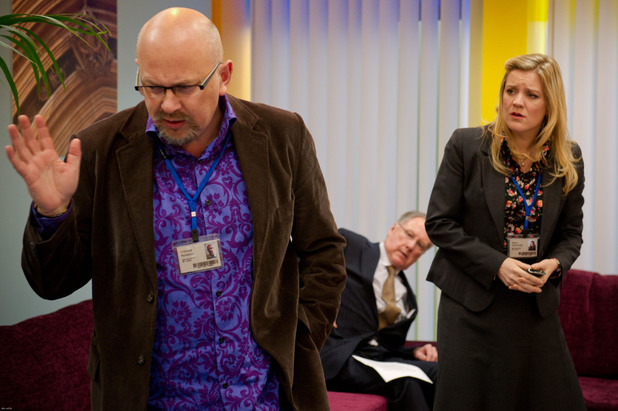
(You know, writing this now I'm amazed all over again that someone who straddled the Holy Trinity of modern British TV comedy – i.e. The Office, The Thick of It, and 2012 – did a reading for me. Thanks again, Vince)
Friday, January 25, 2013
Limehouse photos
I thought I'd create a collage of some of the photos that I'm using to inspire my Limehouse project. Is this a "mood board"? Don't know, but it's useful.


Thursday, January 24, 2013
Looking for inspiration in Limehouse
Just before Christmas I took a trip to Limehouse, part of London’s old docklands. I’m writing about the area for a project called 26 miles. Specifically, I’m writing about one mile of tarmac that runs through Limehouse.
The idea behind the project is simple. Take the 26 miles of the official London Marathon route and allocate each mile to a writer; tell each writer to produce a “creative response” to their mile, in collaboration with an artist from a different discipline. (I’ll post more about my collaborator another time). The writers' collective 26 will publish the resulting work in April, to coincide with the marathon.
My mile is the fourteenth on the marathon route. It runs along two roads: Narrow Street and Limehouse Causeway. I knew it already as I’ve run the marathon three times (or four, I've lost count). This is the point on the course where the streets quieten down, the excitement of reaching Tower Bridge (the halfway marker) has begun to fade, and Canary Wharf –with the endless miles that wind around it like a snake – looms on the horizon.
I walked the mile notebook in frozen hand, camera at the ready, looking for something that would get my creative juices flowing. I struck gold straight away. On Westferry Road there’s an old brick warehouse building. A sign says it is – or used to be – “The Cannon Workshops”. On the wall facing the street there’s a line of twelve clocks. Each one labeled with a different time zone.
A relic of London’s industrial past, I reckoned. Just the spark I needed. I took lots of photos. Pondered and reflected. Got excited.

But a bit of research revealed that these clocks are not what I thought. They’re an art installation by Richard Wentworth. I was disappointed, at first. But I found that I kept coming back to a line in a statement Wentworth made describing the purpose of the work: "Geographical good fortune is the source of London's success, and in their previous form the West India Docks were central to it."
That got me thinking about characters for whom London's geography was a source of disaster, not success. Into the historical archives I went. And that's where I still am. But I'm inspire now. And there are two images that might be important: a photo that I took and a book cover that I found.


The idea behind the project is simple. Take the 26 miles of the official London Marathon route and allocate each mile to a writer; tell each writer to produce a “creative response” to their mile, in collaboration with an artist from a different discipline. (I’ll post more about my collaborator another time). The writers' collective 26 will publish the resulting work in April, to coincide with the marathon.
My mile is the fourteenth on the marathon route. It runs along two roads: Narrow Street and Limehouse Causeway. I knew it already as I’ve run the marathon three times (or four, I've lost count). This is the point on the course where the streets quieten down, the excitement of reaching Tower Bridge (the halfway marker) has begun to fade, and Canary Wharf –with the endless miles that wind around it like a snake – looms on the horizon.
I walked the mile notebook in frozen hand, camera at the ready, looking for something that would get my creative juices flowing. I struck gold straight away. On Westferry Road there’s an old brick warehouse building. A sign says it is – or used to be – “The Cannon Workshops”. On the wall facing the street there’s a line of twelve clocks. Each one labeled with a different time zone.
A relic of London’s industrial past, I reckoned. Just the spark I needed. I took lots of photos. Pondered and reflected. Got excited.
But a bit of research revealed that these clocks are not what I thought. They’re an art installation by Richard Wentworth. I was disappointed, at first. But I found that I kept coming back to a line in a statement Wentworth made describing the purpose of the work: "Geographical good fortune is the source of London's success, and in their previous form the West India Docks were central to it."
That got me thinking about characters for whom London's geography was a source of disaster, not success. Into the historical archives I went. And that's where I still am. But I'm inspire now. And there are two images that might be important: a photo that I took and a book cover that I found.

Subscribe to:
Posts (Atom)